Activating the template: spec-kit, active-feature resolution, blog, and Playwright
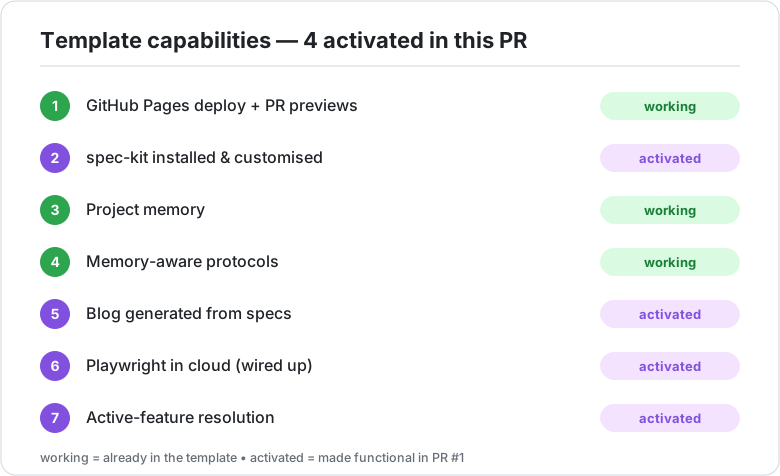
At a glance — four of the template’s seven capabilities went from documented to working in a single PR: spec-kit installed and customised, 3-tier active-feature resolution, blog auto-generation, and the Playwright
package.json.
The problem
REMIT was created from a reusable project-template repository that promises seven capabilities. But a template deliberately leaves some machinery uninstalled — spec-kit in particular is meant to be pulled fresh in each child project, never vendored. REMIT is that child project, so the “install me here” steps had simply never been run. Three capabilities worked (Pages deploy + PR previews, project memory, and the blog publisher); four were only prose in CLAUDE.md:
- spec-kit was not installed at all.
- Active-feature resolution named a
.specify/.active-featurefile that nothing actually read. - Blog auto-generation had a publisher (
deploy.yml) but nothing that wrote the posts. - Playwright shipped a cloud wrapper and config — but no
package.json, so nothing could run.
Options
For the spec-kit-dependent gaps (resolution and blog generation) we weighed three approaches:
- Documentation only — keep describing the patterns and let each developer wire them up. Truest to the template’s “don’t bake it in” stance, but nothing works out of the box.
- Adopt spec-kit’s own mechanism — use upstream’s
.specify/feature.jsoninstead of the documented.specify/.active-feature. Less custom code, but it diverges from the contract thatCLAUDE.mdand.gitignorealready promise. - Install spec-kit and customise it — make the documented behaviour real, keeping our additions in our own helper scripts so they survive upgrades.
Because REMIT is the concrete instance — the place where the patterns are meant to be active — we chose option 3.
The strategy
Install spec-kit (specify init --here --integration claude), then layer small, clearly-fenced REMIT customisations on top:
- A standalone
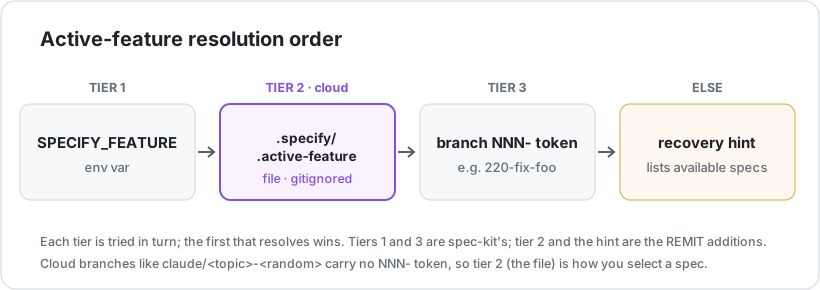
active-feature.shhelper implements tier 2 (read.specify/.active-feature) plus an “available specs + recovery hint” message; two tinyREMIT additionhunks in spec-kit’scommon.shcall it. Tiers 1 (SPECIFY_FEATURE) and 3 (the branchNNN-token) come from spec-kit itself. - A
blog-scaffold.shhelper seedsspecs/<spec>/blog/post.mdfrom the template; fenced steps in thespeckit-plan/speckit-implementskills sketch and then write the post. The publisher (deploy.yml) was already correct, so it is untouched. - A
package.jsondeclares@playwright/test+@sparticuz/chromiumand thetest:e2escripts (wired up, not run).
Keeping the bulk of the logic in our own files means a future specify init re-run only needs a couple of fenced hunks re-applied — recorded in decisions.md (ADR-0004).
The results
All four gaps are closed, and verified in-session:
- Active-feature resolution resolves correctly across all three tiers, and prints a helpful recovery hint (listing the available specs) when nothing matches a cloud branch like
claude/<topic>-<random>. - This very post was scaffolded by
blog-scaffold.shand resolved through the new.specify/.active-featuremechanism — capabilities #5 and #7 dogfooding each other. - Playwright is one
npm installaway from running, with the cloud screenshot path intact.
And the proof you are reading right now: if this post is live at /blog/001-spec-kit-activation/, the blog pipeline — author under the spec, publish automatically on merge — works end to end.
Screenshots
The 3-tier resolution order the patch implements. Tier 2 — the gitignored, per-worktree file — is the one that makes cloud sessions work, because their forced branch name carries no NNN- token: