The ORBAT grows all three sides
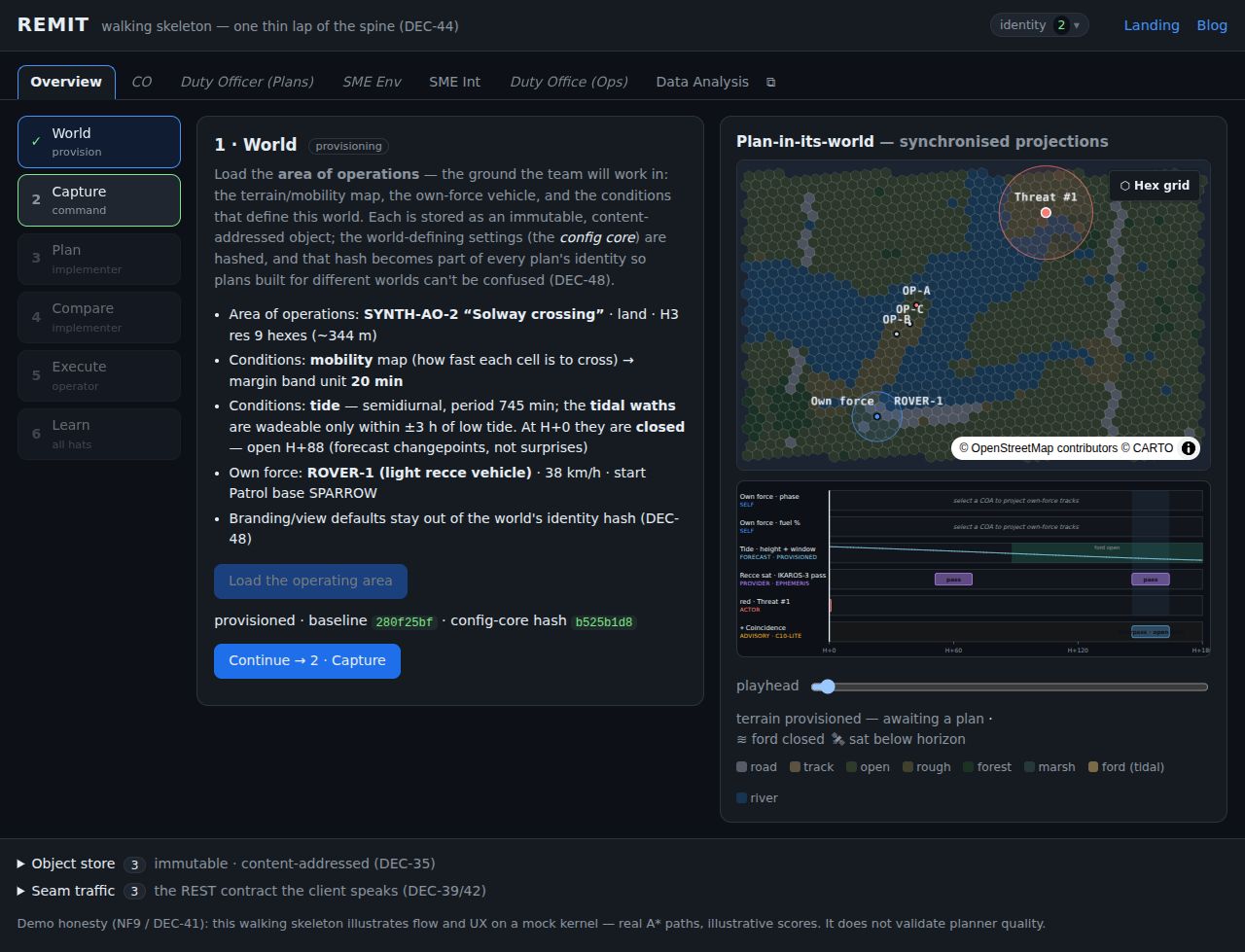
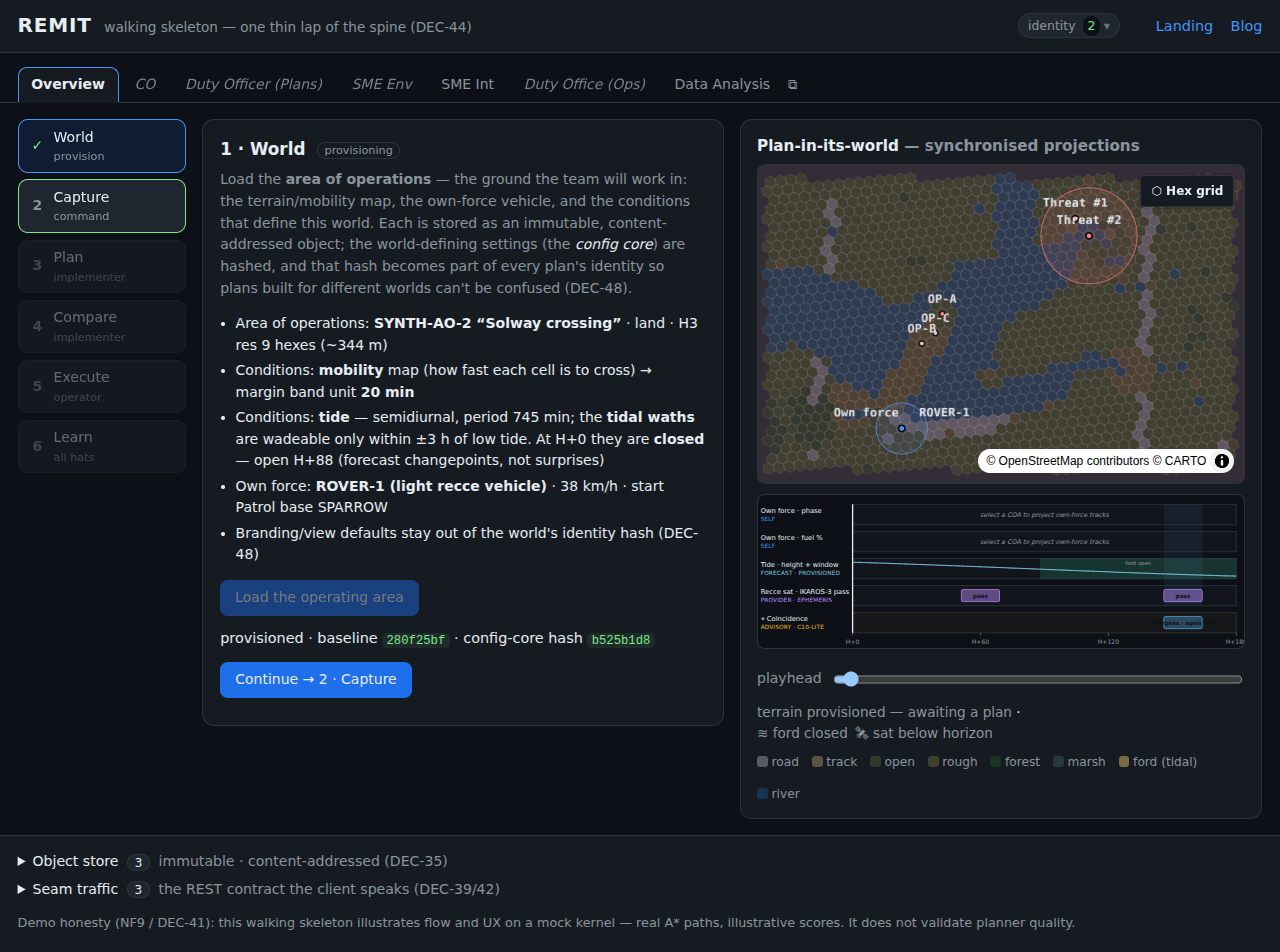
At a glance — the ORBAT now carries all three sides: drop in as many own-force, threat and protected-place assets as a scenario needs, tune each one, and watch them appear on the map and the Sync Matrix — without a single one touching the route.
The problem
REMIT’s entity catalogue was fixed in config and seeded only a single own force. A planner could describe where their vehicle started — and nothing else. There was no way to express the own-force pool, the adversary, or the neutral picture (the no-strike places, the civilian sensitivities) that every real scenario carries. The whole left-hand side of the order of battle was simply missing, and the serialisable shape for it had to live somewhere defensible.
Options
- A new object family vs. reusing Entity. We could mint bespoke
ThreatMarker/RoeZonetypes — or treat every asset as a first-class Entity (DEC-52) that simply carries anallegiance. A parallel family would duplicate the map / Sync-Matrix projection machinery and break the “one ontology, three stances” symmetry of DEC-60. - Free-form map drawing vs. a tunable roster. A draw-on-the-map surface is fun but illegible past a handful of assets; a grouped roster with per-instance tuners stays readable at ten-plus per side.
- Where the data lives — hand-written vs. generated. The persisted ORBAT is serialisable
object-core, so it is exactly what LinkML owns (Principle I). Hand-authoring the shape in
app/jswould be the re-listing anti-pattern. - Blue: display-only vs. wired into the planner. Should authoring a blue pool asset change routing? Not in v1 — the honest floor (NF9) forbids fabricated behaviour, and reactive adversaries / capability-matched allocation are deferred capabilities.
The strategy
Reuse Entity + allegiance and schema-define the shape, then regenerate. We added an
Allegiance enum (blue|red|green) and an optional allegiance attribute to Entity, plus a
new schema/orbat.yaml module (Orbat, Asset, Blue/Red/GreenParams, a Protection enum),
reusing the existing Waypoint / Lineage / TimeWindow. bash schema/generate.sh re-emits
the JSON Schema, the TypeScript types and the HTML reference; the app imports the generated
types and never re-lists them.
All three sides are display-only authoring scaffolding under the DEC-56 horizon split and
the NF9 honest floor. The model module (app/js/orbat/orbat.js) is a pure, deterministic
writer — add / duplicate / tune / remove / validate / canonical / commit — and the
authoring panel (app/js/shell/orbat-panel.js, the SME-Int role-tab) and the map read
through it. Crucially, blue does not drive routing: the existing planned own-force (ROVER-1)
is reconciled as the single canonical_own_force blue asset — protected from removal — and
keeps driving the plan via the pre-existing machinery. Everything projects through the existing
entity → map / Sync-Matrix path rather than a parallel renderer.
The results
- Add / duplicate / tune / remove multiple independent instances of each allegiance, each an
allegiance-coloured map marker (point + faint extent ring + label): blue
#4493f8, red#ff7b72, green#38d39f. - Sync-Matrix tracks for time-windowed assets (a red patrol window, a blue availability window), aligned with the shared playhead; selecting a row highlights it in both views.
- Persistence: the working draft mirrors to
localStorageand survives reload exactly; committing mints an immutable, content-addressedOrbatwith lineage. - The invariants hold, and the tests prove it: tuning anything — including a blue asset — leaves the committed Plan ids byte-for-byte identical (display-only, NF9), and equal rosters canonicalise to equal bytes regardless of insertion order (NF3). 11 new unit tests and 5 new e2e tests (one per user story) are green, alongside the existing suites.
Screenshots
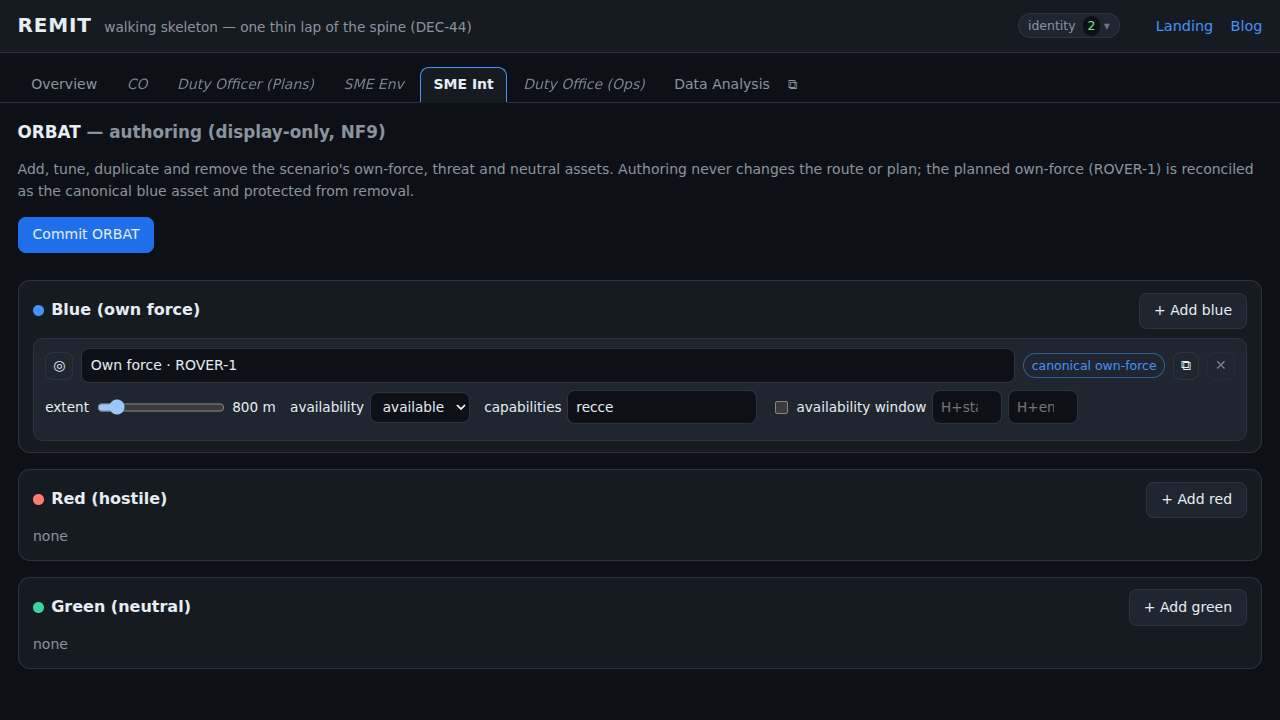
The authoring panel — three allegiance groups, the canonical own-force surfaced and protected:
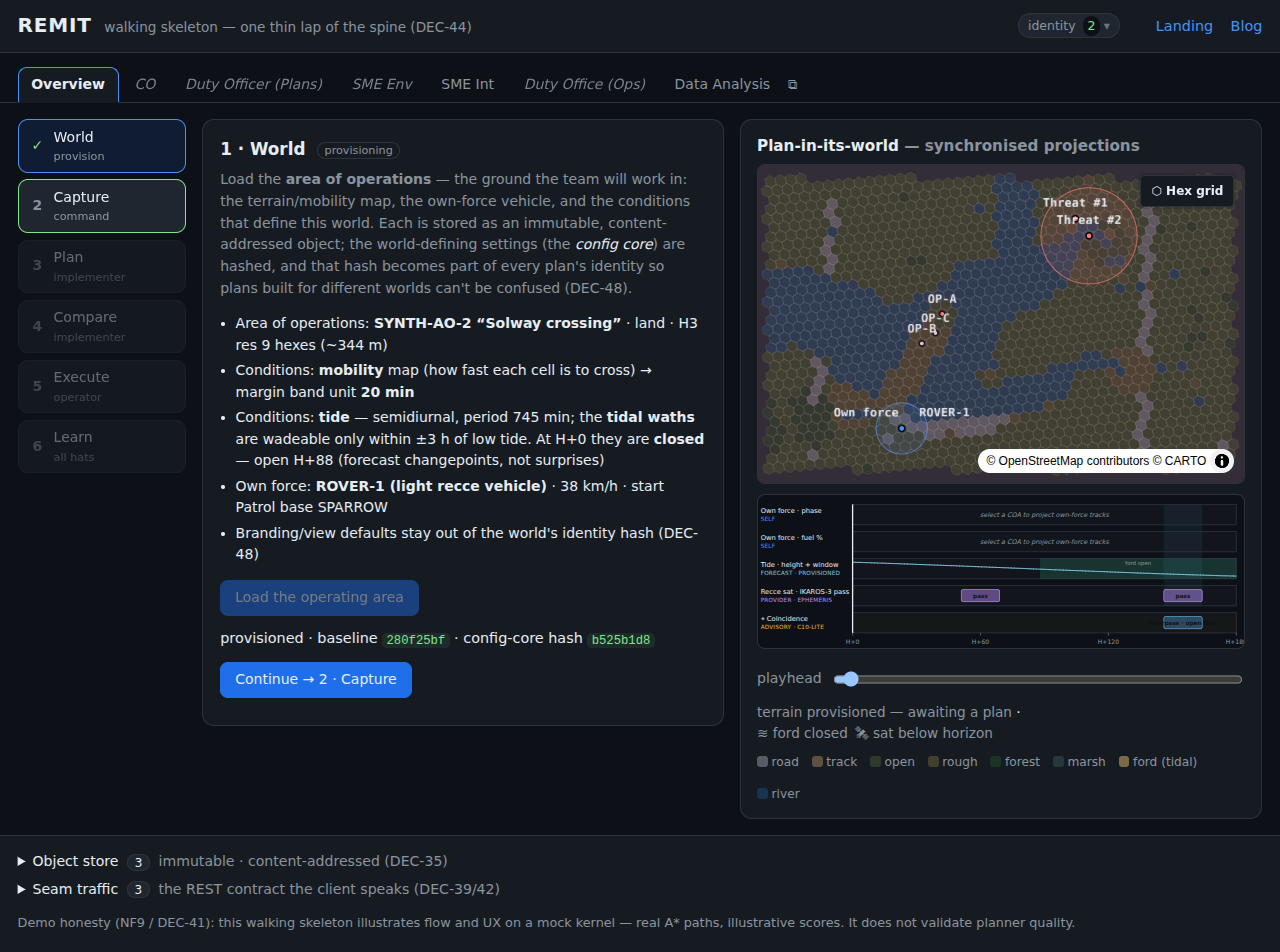
Two red threat assets placed and tuned (extent + severity) on the Solway map:
Green neutral assets, styled distinctly from red and own force:
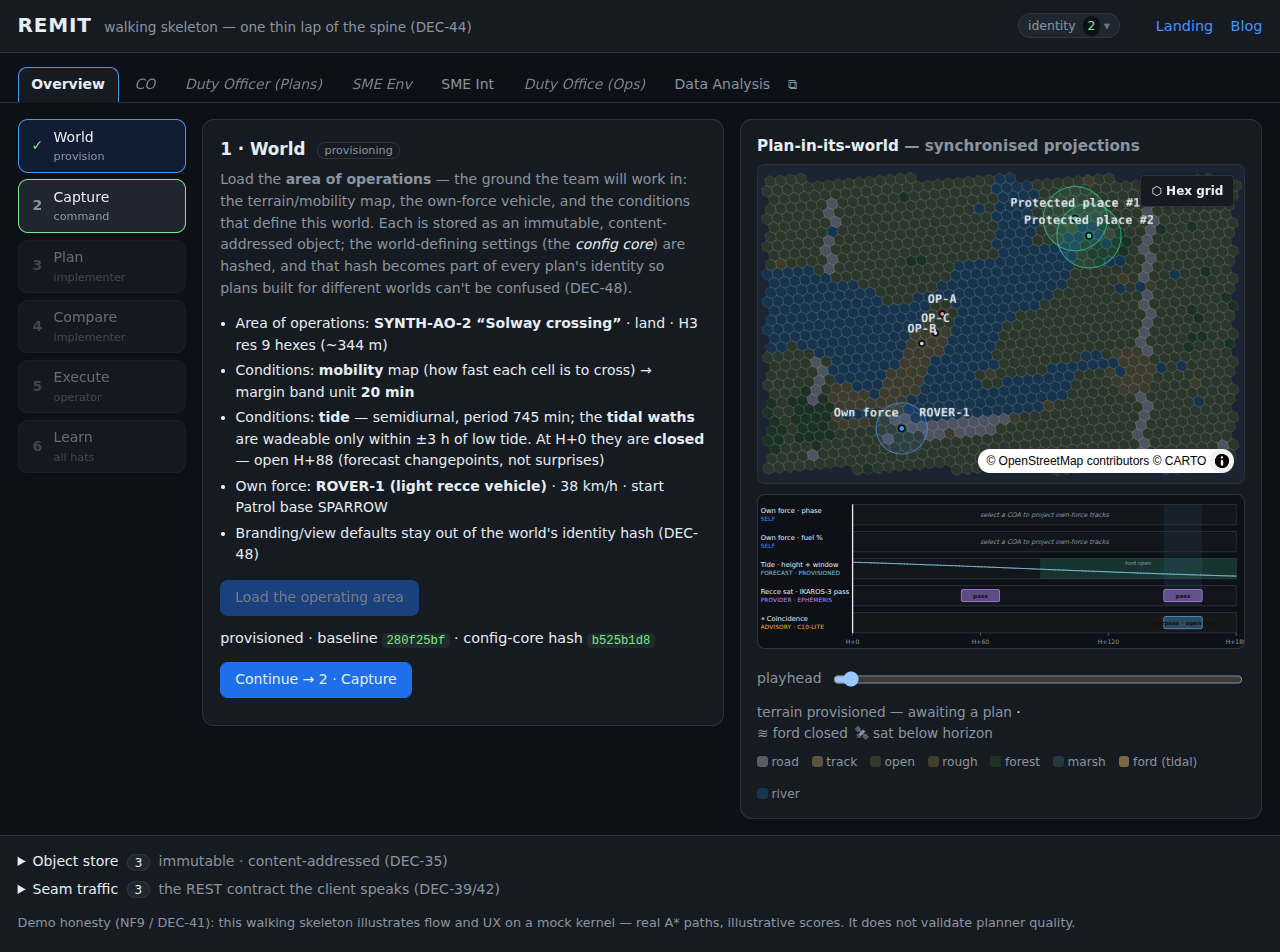
A red asset with an active window projects as a Sync-Matrix track, synchronised with the playhead: