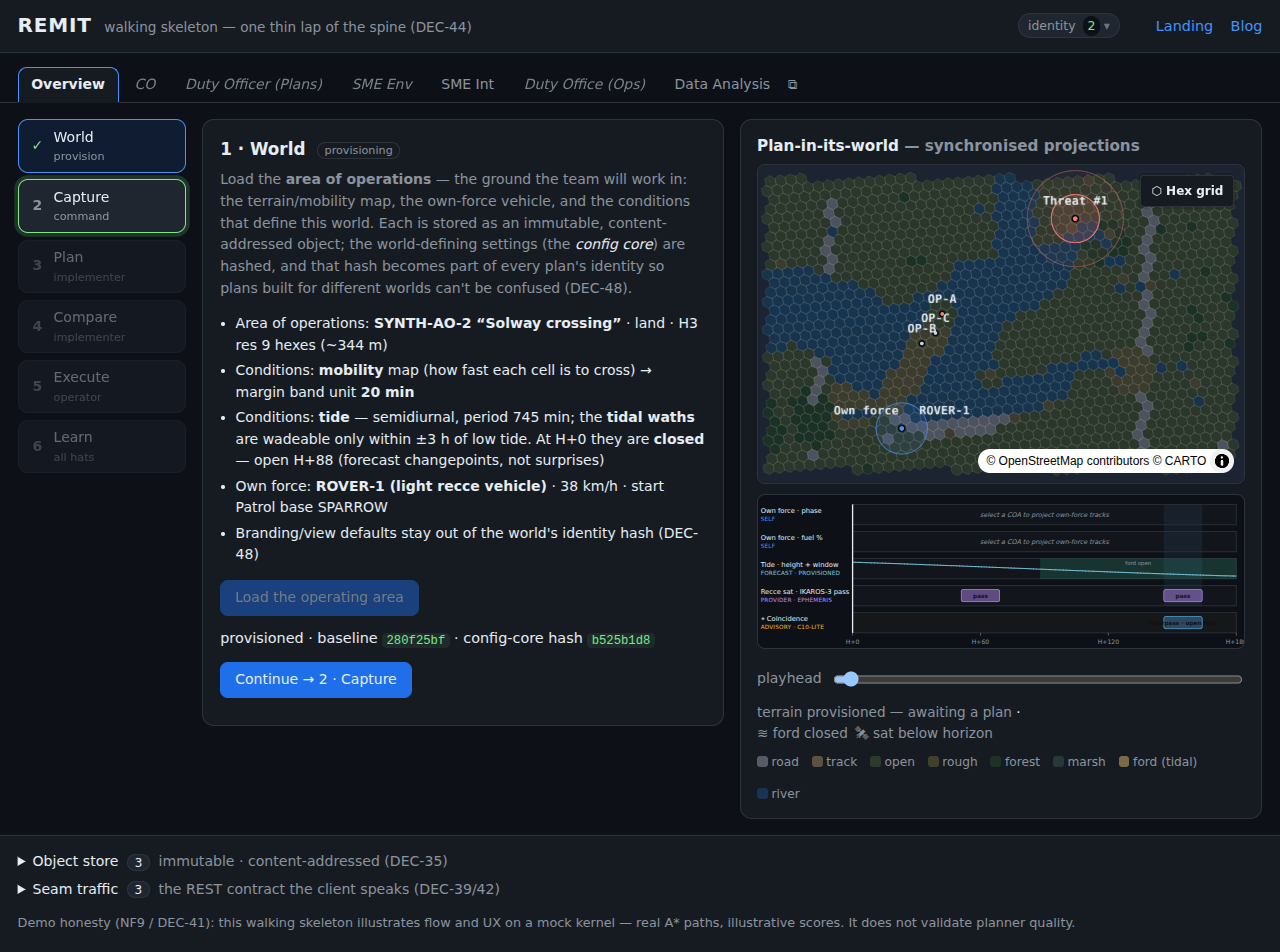
The ORBAT stops being coloured dots
At a glance — ORBAT assets gain typed NATO-style symbols, an intel-confidence wash, a threat’s see-it-vs-hit-it rings, and lightweight descriptive detail — and every one of them stays honest-floor display-only: nothing touches the route.
The problem
Spec 004 gave us a working ORBAT: add, tune, duplicate, remove and commit blue/red/green assets. But every asset rendered as the same allegiance-coloured dot with a single extent ring. You couldn’t tell a hospital from a SAM site, a high-confidence sighting from a rumour, or where a threat could see you versus where it could hit you. The picture had the right sides but none of the texture an intelligence officer actually reasons with.
Options
- Symbology: an engine vs a lookup. A full NATO APP-6/MIL-STD-2525 symbology engine (with affiliation frame shapes) — or a compact glyph lookup table keyed to a handful of platform kinds.
- Rendering: icon atlas vs glyphs. deck.gl’s
IconLayerwith a bundled icon-atlas image — or aTextLayerdrawing a Unicode/emoji glyph over the existing marker (no asset, no new dependency, no build step). - Confidence: a new scale vs reuse. Invent a 0–1 confidence number — or reuse the project’s
existing
ConfidenceLevel(high/medium/low) vocabulary. - Threat reach: one extent vs two. Keep a single radius — or split it into a detection ring and an engagement/weapon ring on the hostile parameter group.
The strategy
Additive, schema-first, and display-only. Every new field is authored in the LinkML schema
(Principle I) and regenerated — a PlatformKind enum and kind/symbol/confidence/strength/
notes on Asset; detection_range_m/engagement_range_m/threat_type on RedParams; a
GreenCategory enum + category on GreenParams; role on BlueParams. The app imports the
generated types and never re-lists them.
Symbols are TextLayer glyphs from a hand-written SYMBOLS lookup (the documented UI carve-out),
drawn over the allegiance-coloured marker — no icon atlas, no new runtime dependency, no build step.
Intel confidence becomes marker opacity (high→full, medium→0.6, low→0.35). Red’s reach splits
into a faint outer detection ring and a bold inner engagement ring, with the model enforcing
engagement ≤ detection. And because spec-004 drafts already live in users’ browsers, a pure,
idempotent normalize() migrates them on load — a red asset’s old single extent_m becomes its
detection range, with an engagement ring seeded inside it.
Crucially, nothing crosses the honest floor (NF9): not one enriched attribute is read by the kernel or any plan. An e2e test re-asserts that tuning any of them leaves the committed plan ids byte-for-byte identical.
The results
- Typed symbols across all three sides (infantry/vehicle/aircraft/vessel/sensor/emplacement/ structure), overridable per asset.
- Intel confidence as a pre-attentive opacity wash on the map.
- Red dual range rings — detection vs engagement — with the engagement ring never drawn larger than detection.
- Descriptive detail — strength, notes, red threat-type, green category, blue role — shown in the roster and on the marker hover tooltip.
- Backward compatible: spec-004 ORBATs load intact and migrate cleanly.
- The invariants hold, and the tests prove it: 12 new unit tests (30 total) and 4 new e2e
tests (9 total) are green, alongside
0typecheck errors. Determinism (NF3) and the honest floor (NF9) are both asserted.
Screenshots
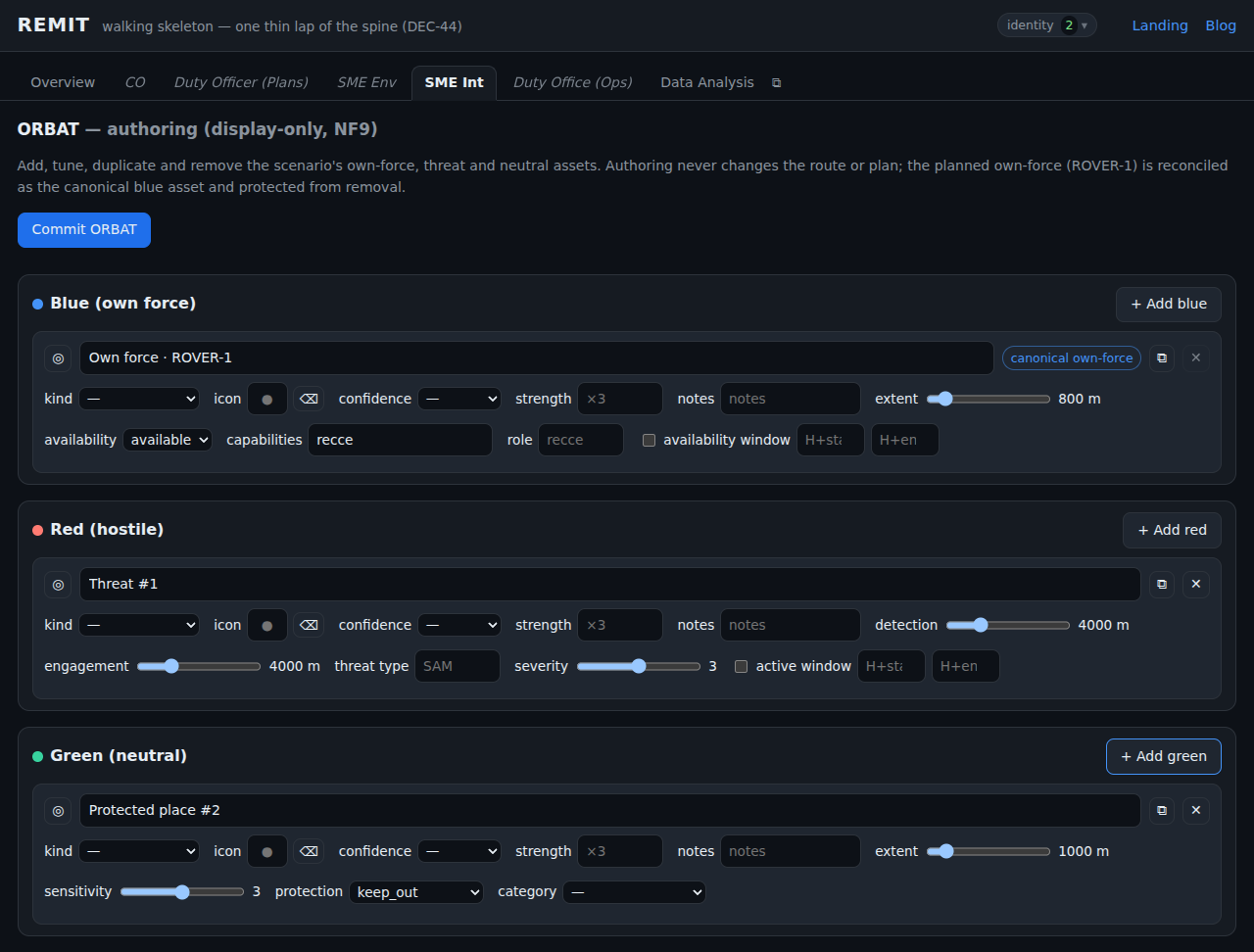
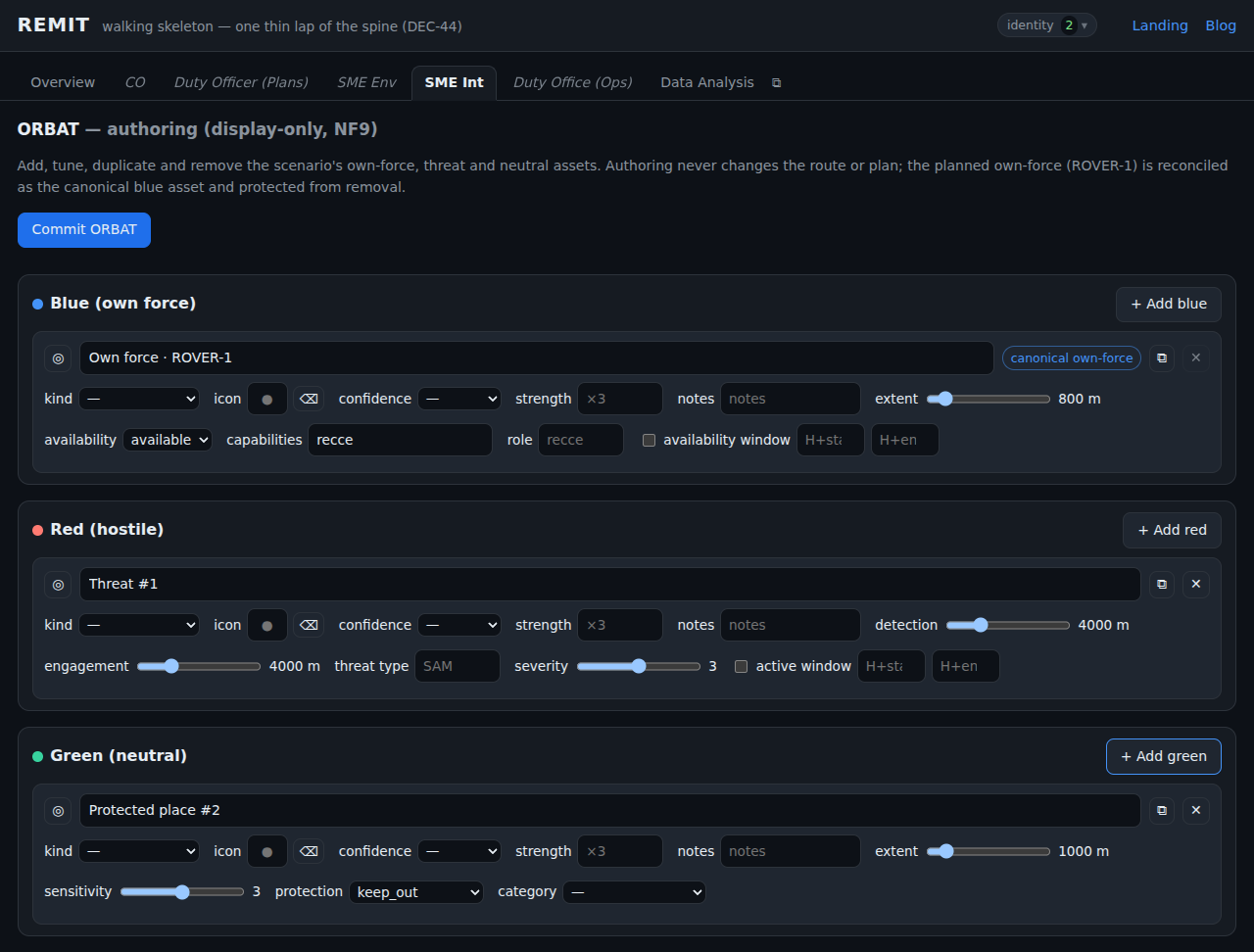
The enriched authoring panel — kind, icon override, confidence, strength, notes; red shows detection + engagement (the single extent is gone for red); green/blue keep their single extent:
The map reads like a recognised picture — typed allegiance symbols in place of plain dots: